and counting
Fort Hills today
camp and drive-in
tagged by mode
From the bus, southbound on 63
Wood Buffalo, Alberta.
, 6:20 p.m.
Dear oil patch worker,
You walk in your own front door. And for about a day, you feel like you're visiting.
Nobody says it out loud. Almost everybody out here has felt it.
Then the next ten minutes of reading are going to explain why.
Here's why.
I'm not going to give you my name. It isn't the part that matters.
Here's the part that does. Twelve years of hitches, and counting.
Nexen Long Lake. Albian Sands. Suncor Base Plant at Steepbank.
Nine years at Fort Hills, where I still work today.
I am not a coach. I have never had a client. I have a badge, a locker, and a bus at 5:30 like you do.
And for years I was very good at the job and very bad at the first day home.
Not dramatically. Nobody files a complaint.
It's short answers at the table. It's being asked a question twice.
It's your kid going to the other parent for something while you're standing right there.
The trip home was the part I never thought about. It was dead time. Scroll, sleep, stare out the window.
Then I'd land, and the changeover would happen in my living room instead. In front of the people I came home for.
And the last night would go sideways. Every time.
An argument about the bag, or a comment, or the dishes. Never about anything.
I filed all of it under “that's just the job.”
Years of that. And one conclusion: the problem is me.
Then one trip home I actually paid attention to what I was doing with those two hours.
And I found the thing that had been beating me. It wasn't the distance and it wasn't the hitch.
Every bit of advice I'd ever been given about home assumed four things.
- That you get an evening. Every day. To be a partner, or a parent, or just a person in a house.
- That the house you come back to is the house you left. Same routines, same rules, same slot for you in it.
- That you and whoever's there are on the same rest cycle. That one of you has something left.
- That leaving is a one-off. Not something you do again in six days, and again after that, all year.
I get none of the four. And on a 4-and-3, I get none of them a hundred times a year.
That's not a relationship problem. That's a changeover with no procedure on it.
Once I saw it, I couldn't unsee it.
So I stopped trying to be a better person when I got home. I built a procedure instead.
Fifteen minutes before I left site. The trip, split into thirds. The first night. The last night and the trip back in.
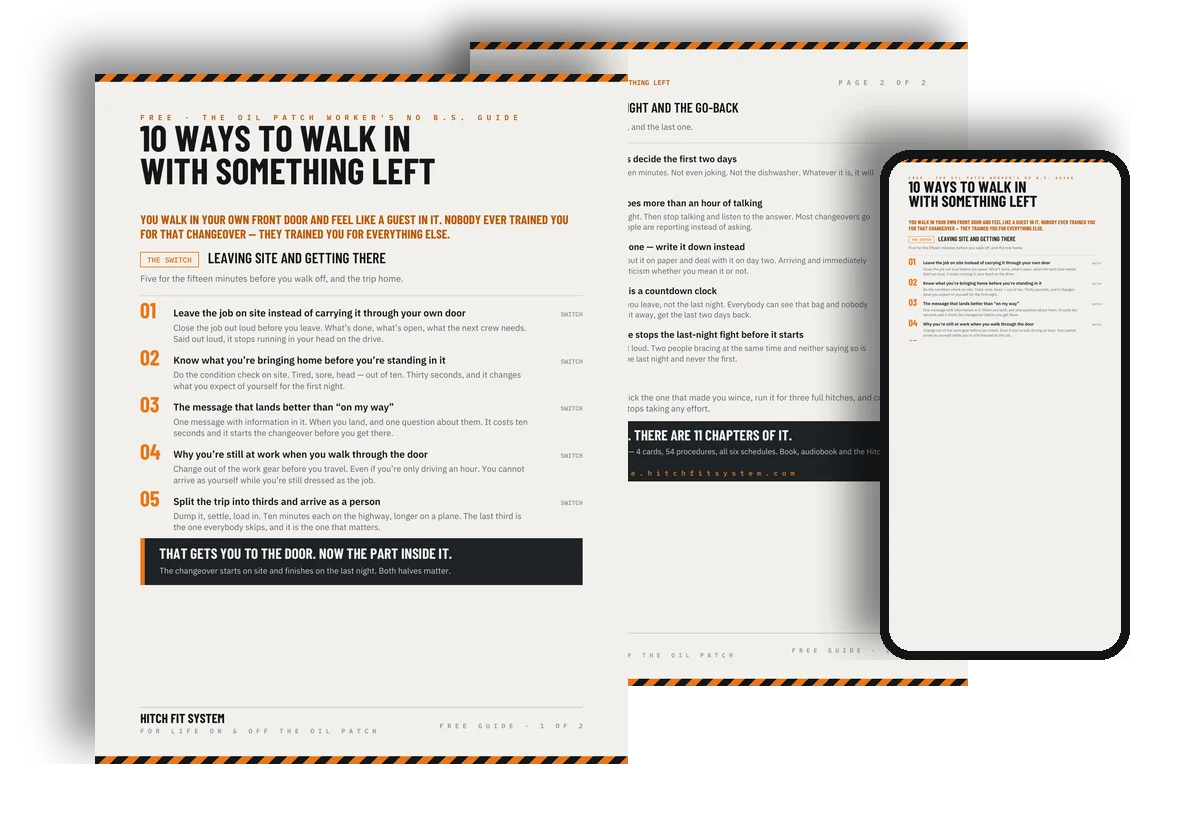
Four short cards. None of them take much time. None of them need anything you'd have to buy.
I ran it on 4/3. On 7/7. On 14/14.
Out of a camp room, and driving in from town. With kids at home, and one stretch with nobody there at all.
It held. Hitch after hitch after hitch.
Not perfectly. I'll say that more than once on this page.
But it held. Nothing else ever had.
People on my crew started asking what I was doing differently.
I'd try to explain it on the bus. That's a terrible way to teach anybody anything.
So I wrote it down. Eleven chapters. Four cards. 54 procedures.
Every one tagged, so you know whether to run it on hitch, on your days off, or on the switch.
It's called The Hitch To Home Protocol, and it's the fifth of five.
Run it on your next trip home. Not next year.
Walk In With Something Left — $67Book + audiobook + the Hitch Fit App · One payment of $67 · Full refund inside three hitches, keep everything
Who this was built for
Is this you?
- Are you a scaffolder, pipefitter, welder or millwright? Twelves on a clock you didn't pick. Would you like to arrive at your own door with something left, instead of spending the first day catching up to yourself?
- Are you an operator coming off a stretch of nights? Your first night home is a flip as well as a homecoming. Ever notice you lose two days to it and never get them back?
- Do you fly out of camp? Two hours on a plane you currently spend scrolling. That's the only gap you get between the two modes, and right now it's doing nothing for you.
- Do you drive in from Fort McMurray, Grande Prairie or Cold Lake? You run this switch twice a day. Four hundred times a year, more than anybody in camp, and nobody's ever written you a word about it.
- Does the last night home always go sideways? A fight about the bag, or a comment, or nothing at all. Then you leave at 4 a.m. with it unresolved.
- Have you come home to a house that ran fine without you? New routines you don't know. A system you're not in. And a question nobody says out loud about who runs it now.
- Are you a few hitches in, or a few hundred? Second marriage, or working hard on the first. Doing the arithmetic on however many hitches you've got left, and not loving the answer.
- Are you a woman on the patch? Reading another thing written as if every worker is a man with a wife at home. Wondering if anyone will write to what you're actually coming back to.
- Do you go home to nobody? No partner, no kids, a place that's been cold since you left. That's its own version of hard and it barely gets mentioned.
Nodded at even one? Keep reading.
The rest of this page is about what's actually going wrong. It isn't your relationship. It isn't you being cold.
First, the door
Four kinds of people should close this page
I'd rather lose the sale than take money from someone this won't fit.
- You go home to the same house every night at the same time. Your problem is a real one. It isn't this one, and there are five hundred books for it.
- You want somebody to fix your relationship in a chapter. Nobody can do that in a book, and this one says so on the back cover. What's in here is a changeover procedure. What you do with the time it buys you is yours.
- You want to be told none of this is your job. Half of these cards are things you say out loud first. If that's not on the table, the rest won't help.
- You're looking for treatment. If what's going on is bigger than coming home and going back, this is the wrong tool. Chapter 10 says exactly that, with real numbers to call.
Still here? Good. Let's talk about the two hours nobody counts.
The arithmetic nobody outside the gate does
Two hours to stop being one person and start being another
You finish your shift. Maybe you shower, maybe you don't. Bag in the truck, or a seat on a plane.
Then a couple of hours of nothing. Scrolling. Half asleep. Staring out the window.
Nothing wrong with any of that. But here's what's happening underneath it.
You spent your hitch in one mode. Wake up, work, eat what's in front of you, sleep, again.
Your body and your head are locked into that pattern. It's how you get through out there.
And in about two hours you're supposed to be a partner. Or a parent. Or a normal person in a normal house.
Nobody switches that fast. Nobody.
So you walk in still running camp software. Short answers. Tired eyes. Half your head still on site.
And the people who missed you most are standing right there wondering why you seem far away.
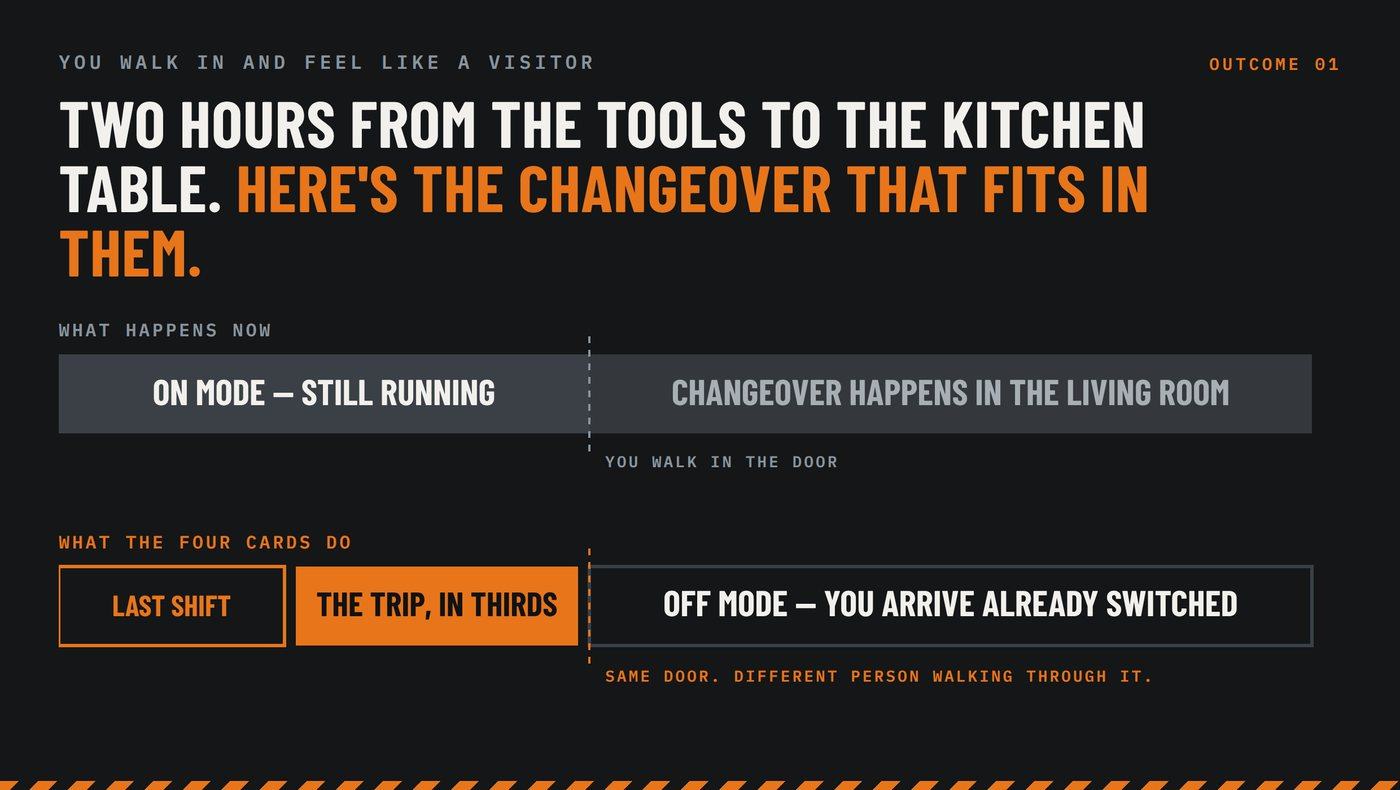
Which means the changeover happens in your living room instead.
That's the whole problem, and it's fixable.
Why the house feels like somebody else's
You walk in. Something's been moved. There's a routine you don't know about.
The kids have an inside joke. There's a system for everything and you're not in it.
Here's why, and it has nothing to do with anybody not loving you.
While you were gone, one person ran all of it. Meals, school, bills, the leaky tap. Alone.
To survive that they built a system. They had to. And that system has no slot for you, because you weren't there.
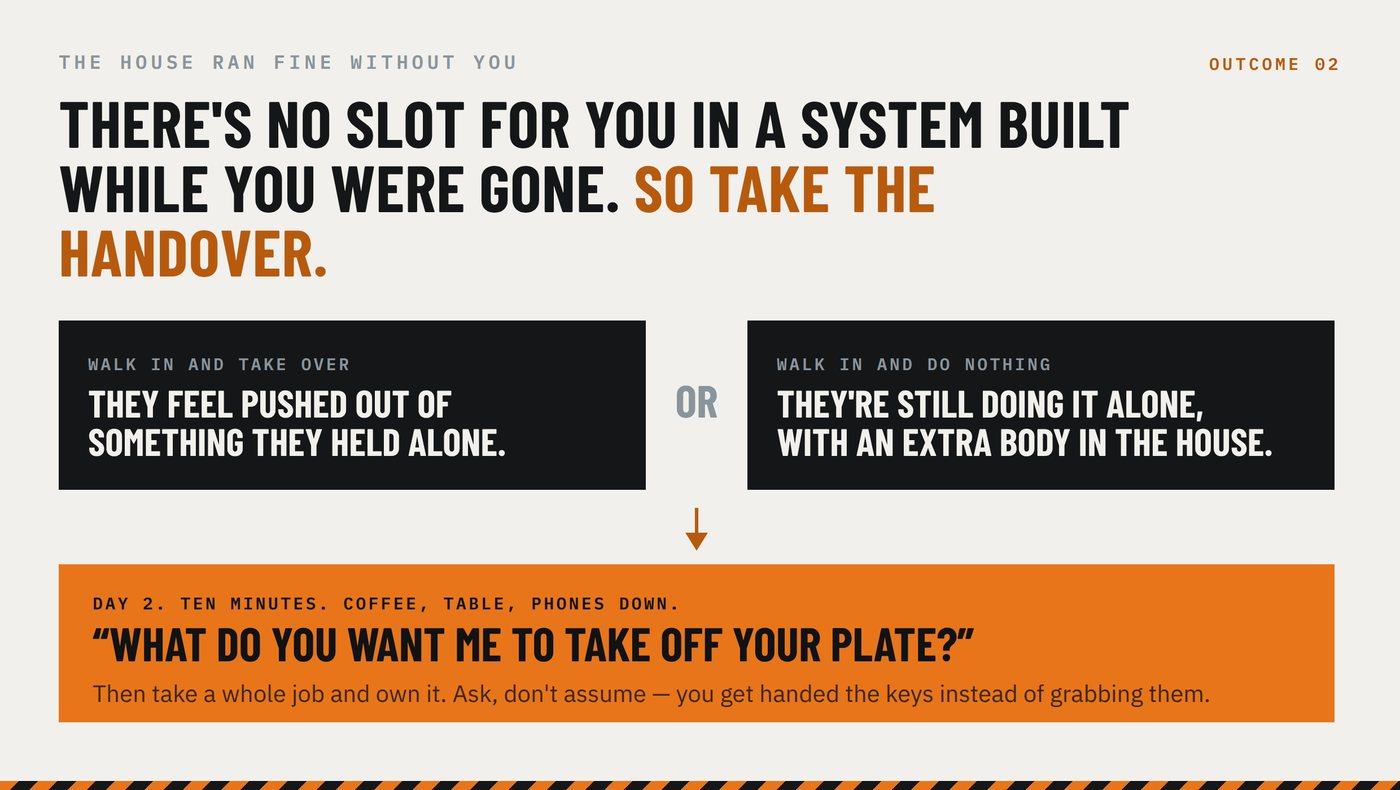
So there's a question hanging in the air that nobody says out loud: who runs the house now?
Walk in and take over, and they feel pushed out of something they held together on their own. Walk in and do nothing, and they're still doing it alone with an extra body in the house.
Neither of those is you being a bad person. Nobody talked about the handover, that's all.
How big the hole is depends on your hitch. On a 4-and-3 the system barely shifted, and the danger is acting like you've been gone a month.
On a 21-and-7 the household genuinely ran three full weeks without you. Habits and rules have actually changed.
Expect that, or you'll spend your week correcting things that aren't wrong.
And you both feel owed a rest
This one causes more arguments than anything else, and almost nobody names it.
You just did your hitch. Twelve-hour shifts, camp food, bad sleep. You're cooked.
In your head, you've earned some rest. Totally fair.
Whoever was home just did the same stretch solo. No backup. Kids, house, their own job.
In their head, so have they. Also totally fair.
You both walk into the same house on the same day, each quietly expecting the other one to take over.
Nobody's wrong. But if nobody says it out loud, it turns into two people keeping score.
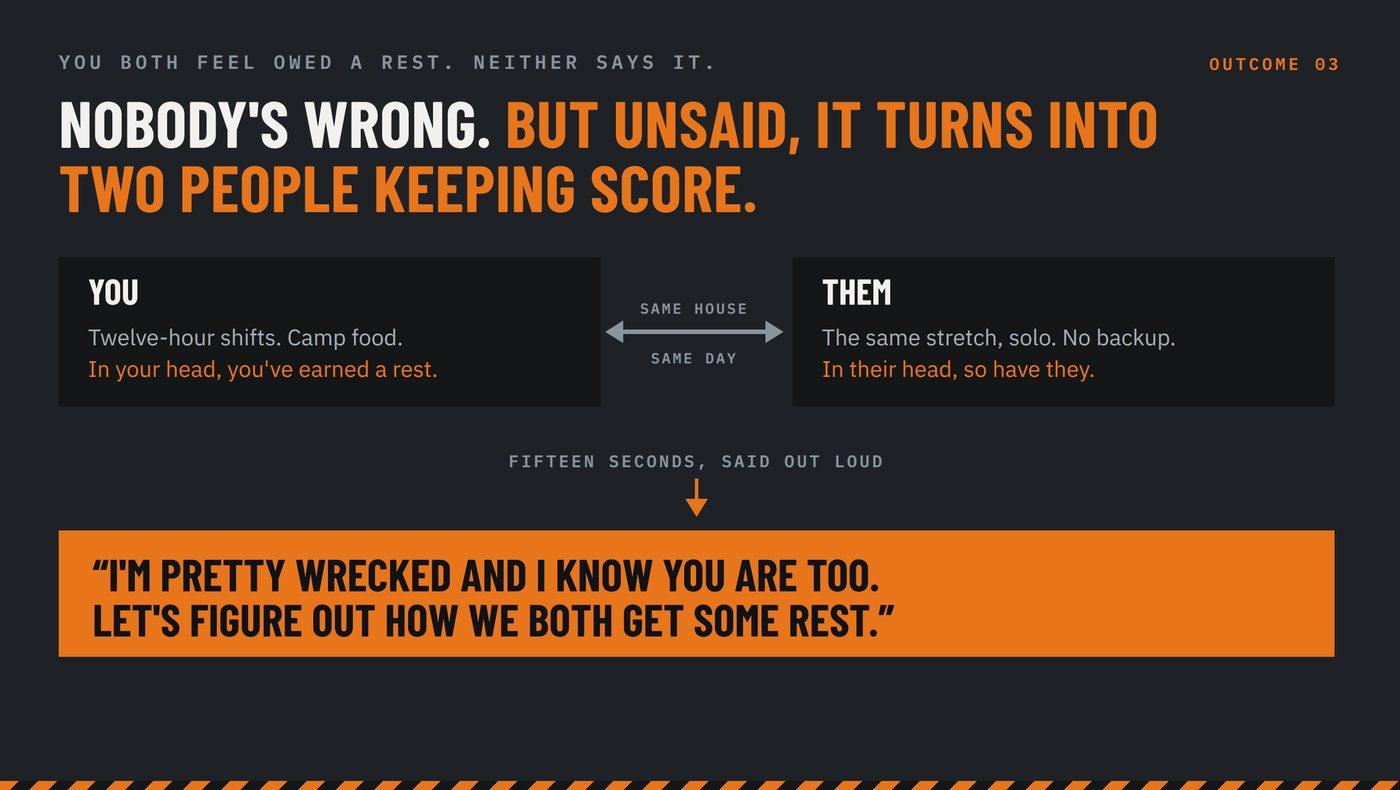
This one bites hardest on short hitches. On a 4-and-3 or a 6-and-6 you're running the same collision fifty or a hundred times a year.
It never gets a chance to reset.
Then there's the last night
Here's the one nobody warns you about.
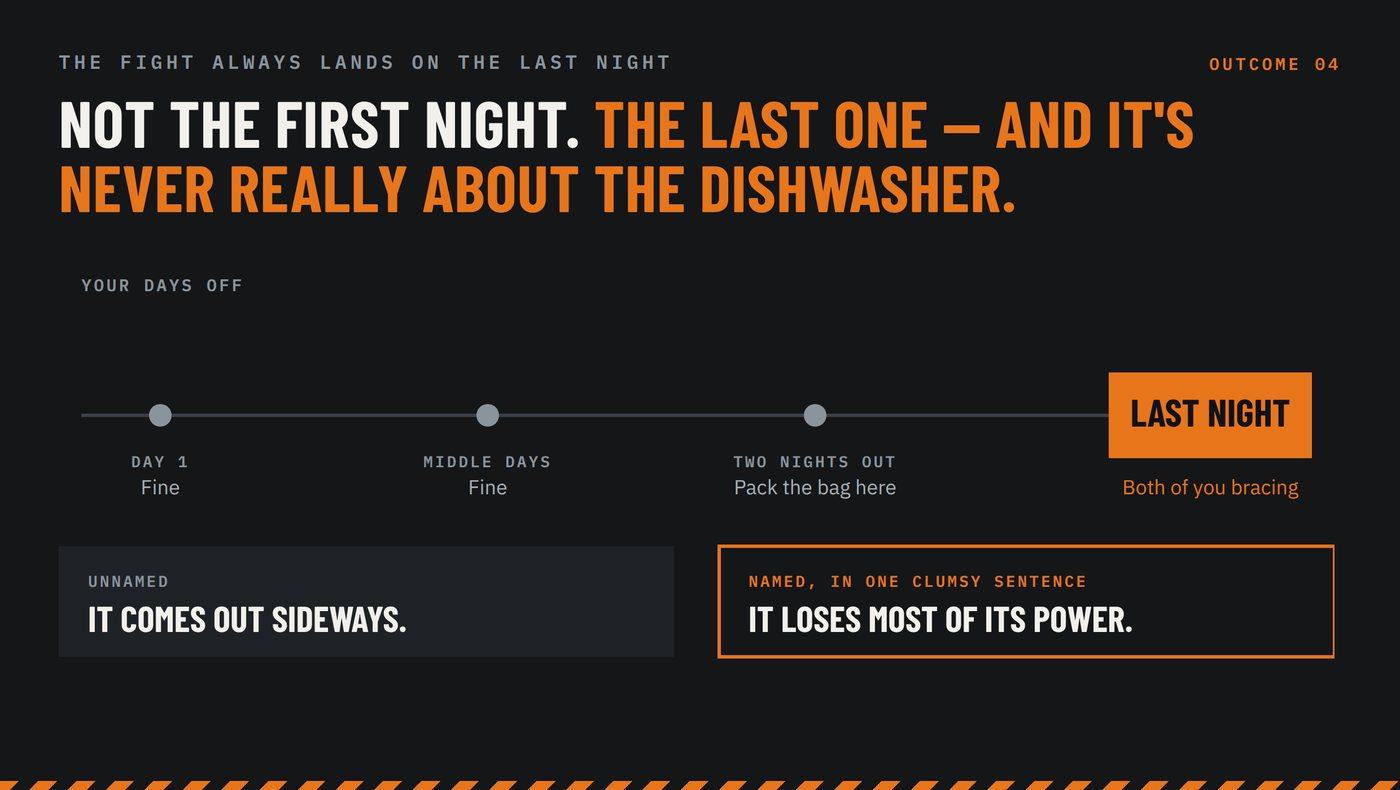
The fight doesn't happen on the first night. It happens on the last one.
Ask around and you'll hear it everywhere. Everything's been fine, and then the night before you go there's an argument out of nowhere.
The bag. A comment. The dishes. Nothing.
It's not nothing.
You're both bracing. You're already half gone — thinking about the alarm, the drive, the next stretch.
Part of you is pulling away, because leaving hurts less if you've already left a bit.
They feel that. And they're bracing too, for another stretch on their own.
Two people who are sad and won't say it, both pulling back at the same time.
That comes out sideways. As a fight about the dishwasher.
And if nobody's waiting
Plenty of people go home to an empty place. No partner, no kids, a house that's been sitting cold.
That's its own version of hard, and it barely gets talked about, because everyone assumes there's a family at the door.
The switch still matters. Probably more.
With nobody there to pull you into the day, it's very easy to arrive and close the curtains. Then lose the whole stretch to the couch.
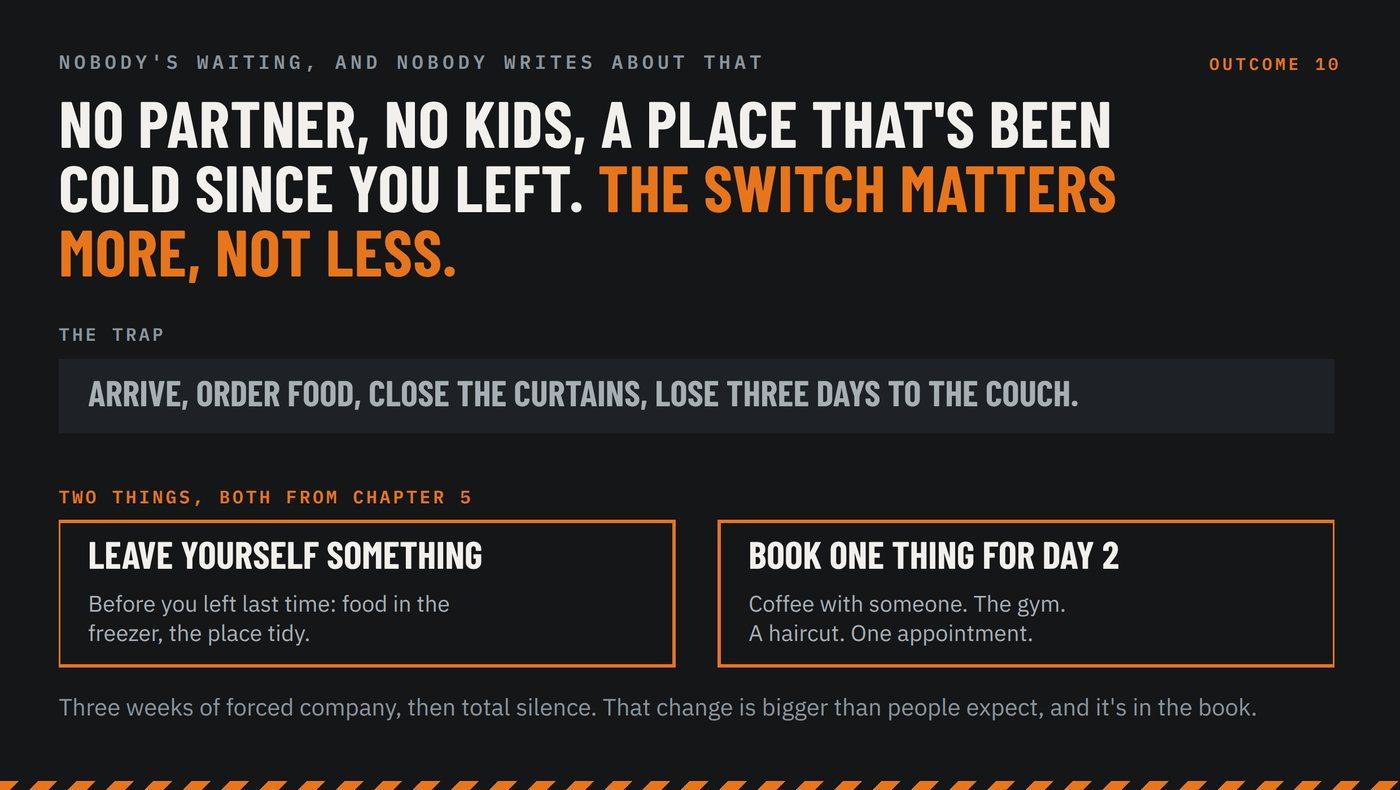
Chapter 5 has a section written for exactly this. Not as a footnote. As its own part of the card.
Do this for years
There's someone out here everybody knows.
Twenty-five years deep. Two marriages gone.
Back's done. Knees, shoulder. Truck's paid off because it's a 2011.
He earned two million dollars over a career. Best-paid work you can get without a degree.
What's left is a truck and a storage unit.
Nobody on that crew is laughing at him. Half of them can see themselves in it, and they know it.
Nobody plans that. It happens one hitch at a time.
The switch never gets managed. The days off never get used. The years quietly stack up.
The job is supposed to pay for the life. Not eat it.
The next changeover is coming either way. Have a procedure for it.
Get The Book And The AudiobookBook + audiobook + the Hitch Fit App · One payment of $67 · Full refund inside three hitches, keep everything
Why this works when trying harder didn't
Built on the On/Off Method — two modes, because you live two lives
One set of rules cannot cover both halves of your year. So there are two, and a changeover in each direction.
On Mode Hold the line
You're on hitch. The job is to get to your days off with something left.
And to keep the middle from being a black hole — because the switch works better on both ends when it isn't.
Off Mode Be there
You're home. Real food, real training, real sleep, real life.
This is the only half where you control your own time. Lose two days of it to re-entry and you've lost the point of the whole arrangement.
The Switch This Protocol is the switch
Day 1 home and Day 1 back. Two changeovers, every single hitch.
Most people have no plan for either one. They show up and hope, then wonder why the first days feel strange and the last night goes wrong.
And it isn't a soft idea. It's the one thing that's been measured.
There is not much published work on this life. There's one study worth knowing about, because it doesn't say what you'd guess.
Researchers followed fly-in fly-out workers and their partners with daily surveys, on shift and off shift, and collected 806 daily reports.
Two things came out of it.
The first: relationship satisfaction was lower on shift than off shift for the workers. Not for the partners.
You feel the separation more sharply than they do. That's the opposite of what most people assume, and it's worth sitting with for a minute.
The second is the one that matters here. That on-shift drop was completely accounted for by time spent communicating.
Once the researchers allowed for the fact that couples talked less while the worker was away, the difference disappeared.
Nothing was left over for the distance, or the camp, or the hitch itself to explain.
Forshaw, Alfrey, Vandelanotte, Gardner and Rebar, PLOS ONE, 2025. Two honest notes: it was a small study — 106 people, only 19 of them actual couples — and the reviewers said so. And it shows a pattern, not a cause.
Read what that says.
It is not the distance. It is not the camp. It is not the hitch.
You cannot shorten the hitch. You cannot move the camp closer.
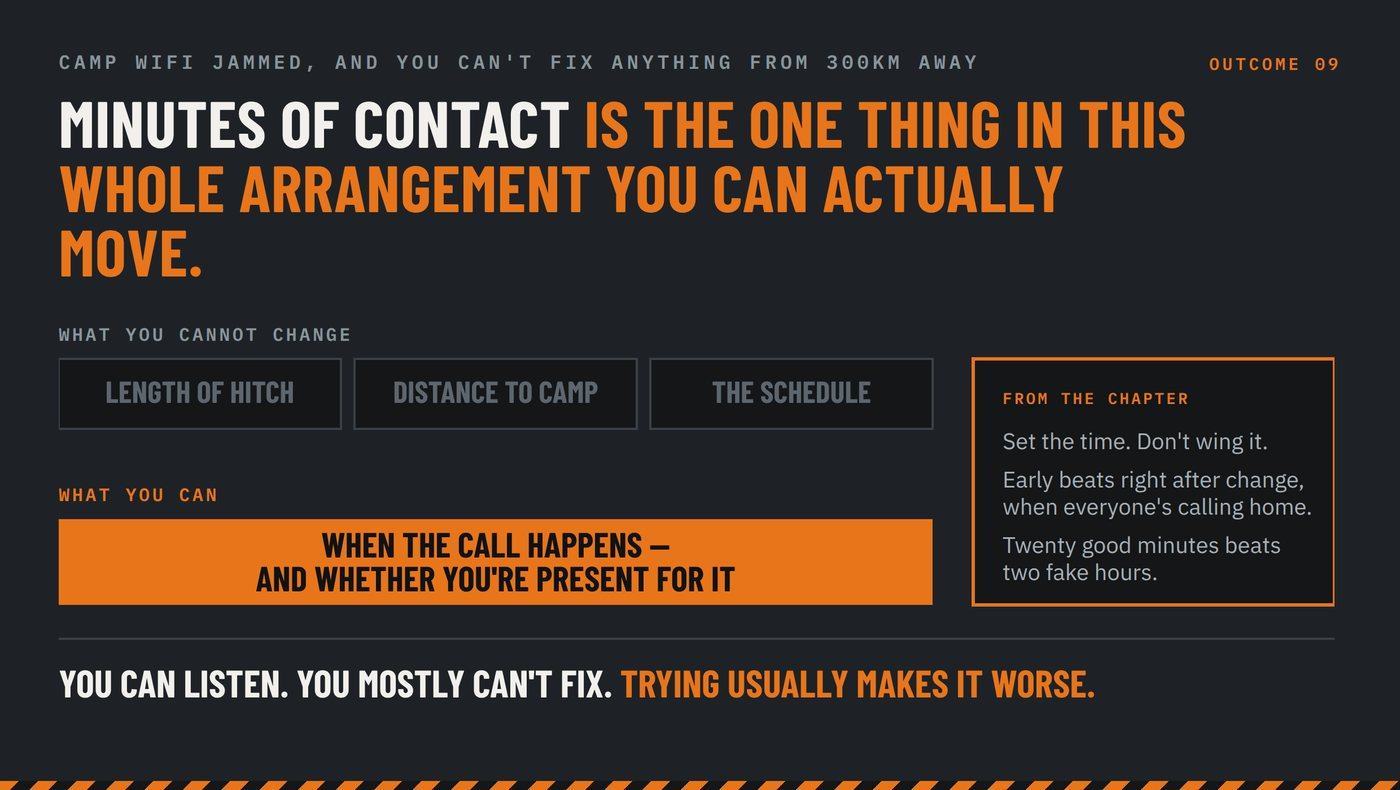
You can decide when the call happens, and whether you're present for it. That's a procedure, and it's Chapter 9.
Inside the book
31 things in here nobody ever told you
11 chapters, 4 cards, 54 procedures. Every one tagged On Mode Off Mode or The Switch so you always know when to run it.
- You need to get home before the changeover can start, right? Wrong. It starts on site, fifteen minutes before you walk off. Do it there and you arrive switched over instead of switching over in the living room. — Chapter 3
- 5 steps, 15 minutes, before you leave site. Two of them take two minutes each and one of them changes how you get met at the door. — Chapter 3
- What you should never send as your last message off site. “On my way” does none of the three jobs that message needs to do. The book gives you the version that does all three. — Chapter 3
- The dirty truth about the trip home — it's the most valuable two hours of your hitch. Split into thirds, it does the whole changeover for you. Right now it's doing nothing. — Chapter 4
- 3 parts to any trip home, whether it's a plane, the camp bus, or thirty minutes down 63. Same job each time, and the last third is the one everybody skips. — Chapter 4
- Where to put the hitch so it doesn't come home with you. There's one place it's meant to go, and it isn't your kitchen at nine at night. — Chapter 4
- The condition check that stops you snapping at somebody over nothing. Three numbers out of ten, two minutes, on site. There's a big difference between walking in tired and walking in tired and knowing it. — Chapter 3
- How to stop arriving in your coveralls. If you drive home in your work gear you're skipping the changeover completely and going straight from site to kitchen table. Five minutes fixes it. — Chapter 3
- The 3 things to sort out before you land — and why picking three beats hoping for twenty. On a 21-and-7 three is genuinely all you'll get. On a 14-and-14 you carry three and then pick three more. — Chapter 4
- Say goodbye to walking in with no idea what happened while you were gone. Ten minutes of your messages, read properly instead of skimmed, on the last third of the trip. — Chapter 4
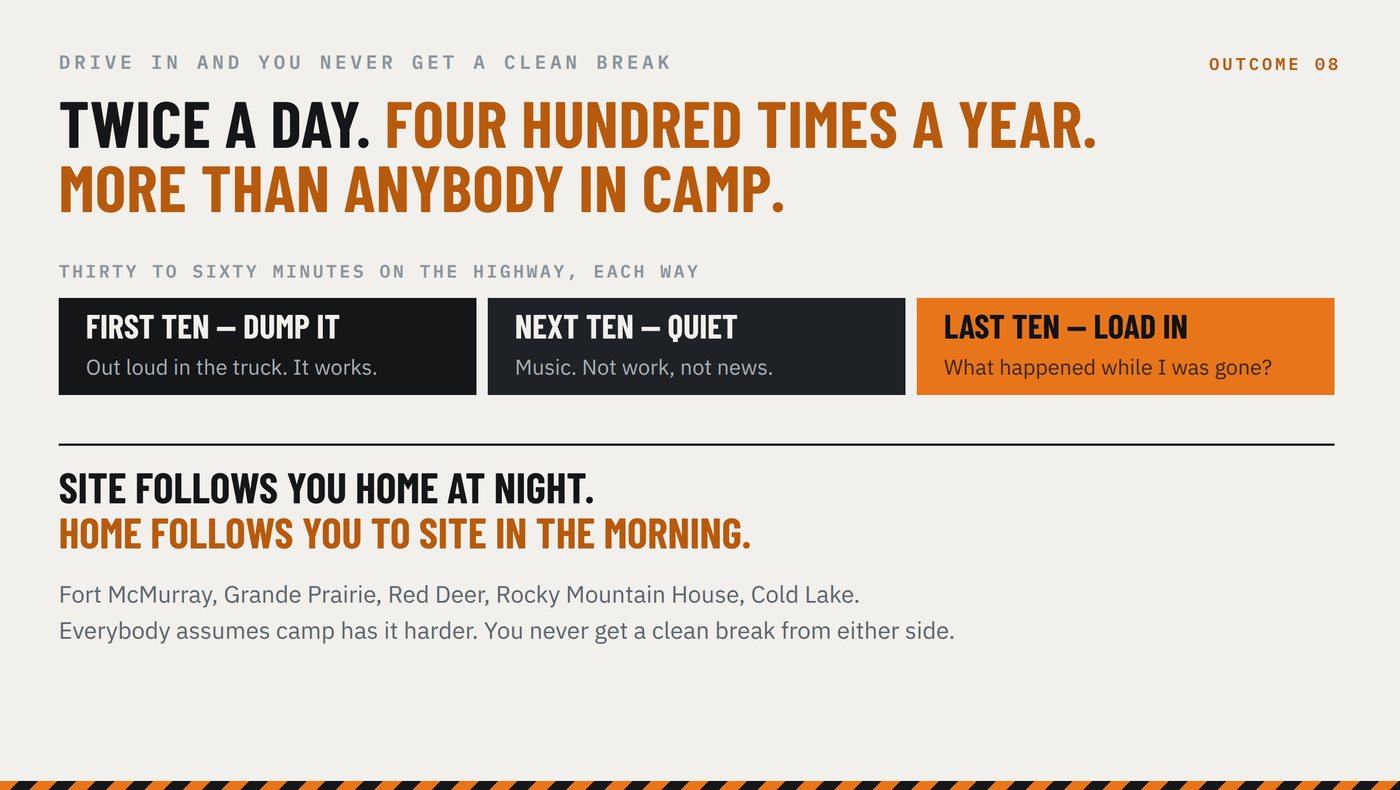
- If you drive in every day, the whole thing compresses. Ten minutes, ten minutes, ten minutes. You run this switch twice a day, four hundred times a year, and nobody has ever written you a procedure for it. This is it. — Chapter 4
Book + audiobook + the Hitch Fit App · One payment of $67 · Full refund inside three hitches, keep everything
Landing
The 10 minutes that decide your whole days off
- You need a big warm reunion on night one, right? Wrong. That expectation is exactly why both of you quietly feel let down on Day 1. The book tells you to lower the bar on purpose, and why that works. — Chapter 5
- What you should never do in the first ten minutes. Five things, and four of them feel completely reasonable at the time. One of them is the dishwasher. — Chapter 5
- The 7 words to lead with instead. Then stop talking and listen to the answer. That's the entire opening move. — Chapter 5
- How to stop the rest-time collision turning into a week of keeping score. One sentence, fifteen seconds, said out loud on night one. It prevents about half the arguments that happen on days off. — Chapter 5
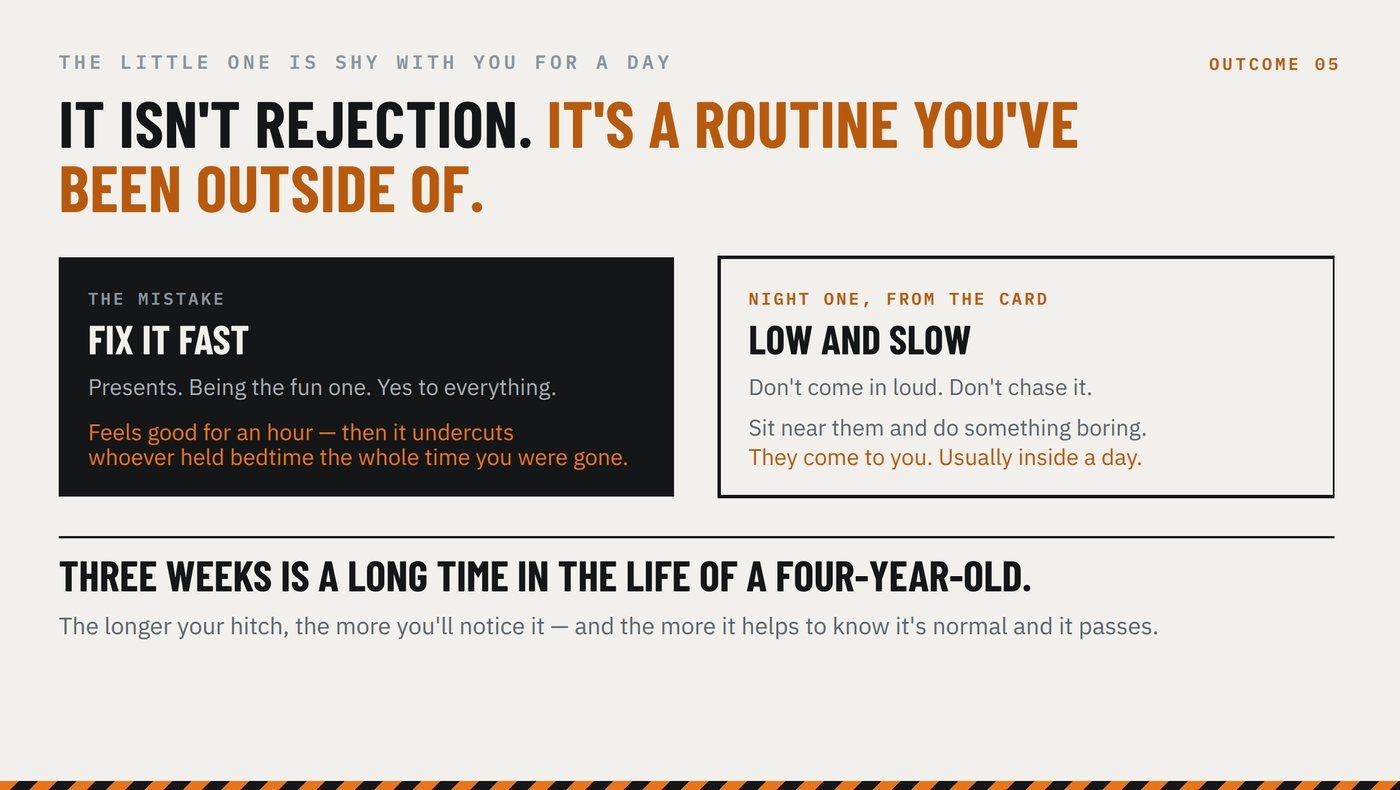
- The truth about a kid being shy with you for a day. It isn't rejection and it isn't your fault. And the usual fix — presents, being the fun one — undercuts whoever held bedtime while you were gone. — Chapter 5
- Why you should never fix anything on night one. The house, the schedule, the money, the thing your kid said. Tired people make bad calls and say things sharper than they mean. Write it down. — Chapter 5
- 2 things to do if you're coming home to an empty place. One of them you do before you leave last time. The other is a single appointment that stops the whole stretch turning to mush. — Chapter 5
- Where to find the handover you never got. Ten minutes on Day 2. Coffee, table, phones down, three questions. The third one is the one that matters. — Chapter 6
- How to stop “helping out” and actually take something off their plate. Helping still leaves the other person managing you. There's a difference and the book is blunt about it. — Chapter 6
- The 2 things that eat the middle days, and they're opposites. One is drifting back to work in your head. The other is no structure at all. Both are named, both have an answer. — Chapter 7
Leaving again, and the middle
The 1 sentence that stops the last-night fight
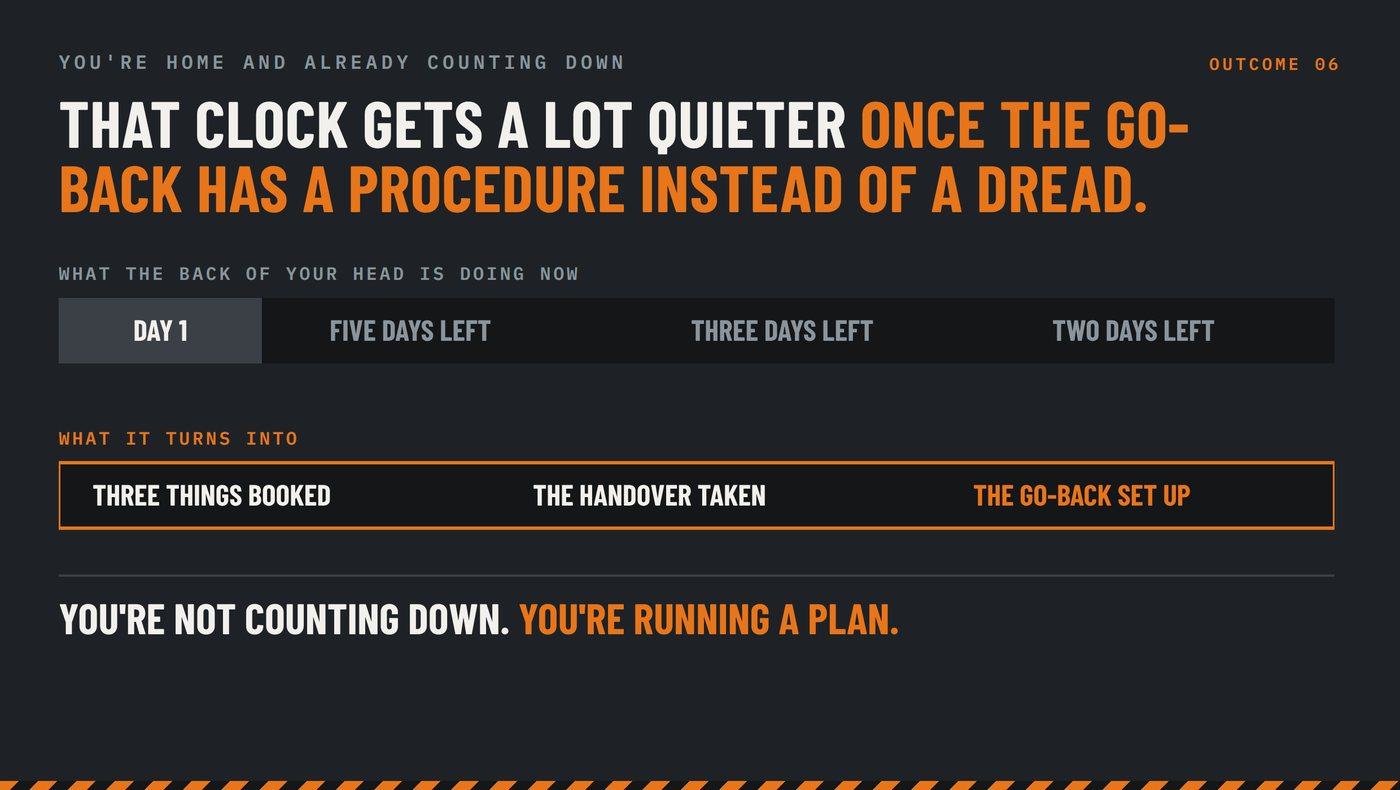
- You should pack the night before you leave, right? Wrong. Pack two nights early. The bag by the door is a countdown clock sitting in the middle of your living room. — Chapter 8
- The truth about why the last night goes bad. It's not the dishes and it was never about the dishes. Two people bracing at the same time, and neither of them saying so. — Chapter 8
- The one clumsy sentence that stops more last-night fights than anything else I know. It's printed in the book word for word. It takes about four seconds to say. — Chapter 8
- How to hand over the next hitch instead of just leaving. Ten minutes together, three questions, actual times. Same as a shift change, because that's what it is. — Chapter 8
- What you should never do on the morning you go, even at 4 a.m., even if everybody's asleep. It feels considerate. It doesn't land that way. — Chapter 8
- Reverse the thirds on the way in. Sad first, settle second, load in last. You arrive switched on instead of spending Day 1 catching up to yourself. — Chapter 8
- Where to find twenty good minutes when camp wifi is jammed. A few thousand people all calling home after change. There's an off time that's reliably clearer, and it isn't the obvious one. — Chapter 9
- How to stop trying to fix things from three hundred kilometres away. You can listen. You mostly can't fix. Trying usually makes it worse, and the book gives you the sentence to use instead. — Chapter 9
- Match the contact to the hitch. On a 4-and-3, daily calls can feel forced — you'll see them in three days. On a 21-and-7 daily contact isn't optional, because drift is far harder to fix than to prevent. — Chapter 9
- When to close the book and talk to somebody. Its own chapter, in plain language, with real numbers in it. There is no version of this where asking is the weak move. — Chapter 10
Book + audiobook + the Hitch Fit App · One payment of $67 · Full refund inside three hitches, keep everything
Before you decide you've heard this before
7 things you've already tried. Here's exactly why each one died.
I'm not going to pretend you've been sitting on your hands. You've tried to fix this. So have I.
Here's the honest post-mortem on every option in front of you. Including the ones I'd still tell you to use.
- Calling home every single night. Good instinct, wrong execution. A long call where you're half scrolling is worth less than twenty minutes where you're actually present, and people can always tell. What's different: a set time, matched to your hitch length, and one rule about what you talk about.
- Bringing something home for the kids. It feels good for about an hour. Then it quietly undercuts whoever's been holding bedtime and homework the whole time you were gone. What's different: low and slow on night one. Then a Day 2 handover where you take a whole job instead of buying your way back in.
- “I'll make it up to them next hitch.” The most common one. It moves the problem to a version of you who's also going to be tired. What's different: three things, chosen on the trip home, in the calendar with actual times before Day 2 is over.
- Talking to someone about it. Not a scam and not a failure — genuinely useful, and Chapter 10 tells you when it's the right call. But a counsellor can't be in the truck with you at 6 p.m. on the last night. What's different: this is the procedure for the two changeovers. It sits alongside that, it doesn't replace it.
- Sleeping the first day off and starting fresh on Day 2. Reasonable, and on a 14-and-14 you can maybe afford it. On a 7-and-7 you just spent a seventh of your time off. What's different: the first night has one job. Get in the door soft, and it's built to be run when you're wrecked.
- Being the fun one for a week. Yes to everything, no bedtimes, big plans. Then the last night arrives and both of you are strange with each other and neither knows why. What's different: the last night gets its own card, and the reason it goes wrong is named out loud.
- Nothing. Just gritting through it. Costs the most, because it quietly teaches you the problem is your character. What's different: the problem was never your character. It's a changeover you run twice a hitch that nobody ever gave you a procedure for.
So what's actually different about this one?
One thing. Everything above tries to fix the time you're home. This fixes the two hours before it and the last night at the end of it.
Arrive still in On Mode and the first day is gone. On a 7-and-7 that's a seventh of your time.
Leave without handing over and the last night goes sideways, and you carry that back onto site with you.
That's not a marketing angle.
It's the two ends of every hitch you'll ever work, and neither one has ever had a procedure on it.
You don't have to believe me. You have to run it for three hitches.
If it hasn't earned its place in your kit, you get the money back and keep the books.
Fair enough
Take a peek inside the book…
Three pages, lifted straight out of it, unedited. Click any page to bring it to the front.

Four of the diagrams inside · The four cards · The Last Shift Card · The trip, in thirds · Why the last night goes bad
The Switch Two minutes, before you leave site. Be honest. Rate three things out of ten:
- Tired — how deep is the hole?
- Sore — anything actually hurt, or just worn?
- Head — flat, wound up, or okay?
You're not fixing anything here. You're just knowing what you're bringing home. There's a big difference between walking in tired and walking in tired and knowing it.
The second one lets you say “I'm running on empty, give me tonight” instead of snapping at somebody over nothing.
Excerpt · The Hitch To Home Protocol
Off Mode Don't lead with a problem.
Don't comment on the state of the house. Don't ask why the thing didn't get done. Don't start fixing anything. Don't reorganize the dishwasher.
I know. The dishwasher is loaded wrong. Let it go.
Your partner has been running everything alone. A criticism as your first line — even a small joking one — lands ten times harder than you mean it.
Lead with this instead, and mean it:
“Thanks for holding it all down. How are you doing?”
Then stop talking and listen to the answer.
Excerpt · The Hitch To Home Protocol
The Switch You're both bracing.
You're already half gone — thinking about the alarm, the drive, the bus, the next stretch. Part of you is pulling away because leaving hurts less if you're already a bit detached.
Your partner feels that. And they're bracing too, for another stretch alone.
Two people who are sad and won't say it, both pulling back at the same time. That comes out sideways. As a fight about the dishwasher.
Once you can see it, it loses most of its power.
Excerpt · The Hitch To Home Protocol
That's the voice of the whole book. No hype, no shame, no “crush it.” Just the thing to do, and when to run it.
The part where a page like this usually shows you 6,000 five-star reviews
There are no testimonials on this page. Here's why.
This book launches on September 10, 2026. Nobody has run it for three hitches yet, because three hitches haven't happened yet.
I could go get some. You know how it works.
A few glowing quotes. Stock photos. Initials and a job title. Half the pages you've bought from did exactly that.
I'm not doing it. Not because I'm a saint. Because you work out there, and people who work out there can smell it.
One fake quote from “D.M., Pipefitter” and you'd close this page. You'd be right to.
And on this subject it would be worse than usual. Inventing a quote about somebody's marriage is a different order of thing.
So here is every piece of proof I actually have, and nothing else:
- Twelve years of hitches, and counting. Nexen Long Lake, Albian Sands, Suncor Base Plant at Steepbank, and nine years at Fort Hills — where I still work today. Not “I did twelve years and left to write a book.” I'll be on shift while you're reading this.
- All six schedules, actually run. 4/3, 6/6, 7/7, 14/7, 14/14 and 21/7. Longest lived on 4/3, 7/7 and 14/14. Camp rooms and driving in, both. Minus forty.
- One published mechanism, stated honestly, with the sample size and the limits printed next to it. It's in the section above. I'd rather you saw the caveats than didn't.
- Three excerpts above, printed in full, so you can judge the writing instead of the promises.
- A guarantee measured in hitches, not days, because a 30-day guarantee is meaningless on a 21/7 and everybody selling one knows it.
When there are real ones, they'll go here, with real names from real crews. Until then, this space stays empty and honest.
What the research actually says
The problem is documented. Almost nobody talks about it.
of workers surveyed said they would not seek support for their health on the job — over stigma, and over not being rehired.
Dorow and colleagues, University of Alberta.
In the same body of work, 87% reported some or a lot of stress. 35% had sought help in the past year.
Read those two together and you get the actual shape of it.
Nearly everybody is carrying something. Roughly a third do anything about it.
I'm not going to use that as a threat. It isn't a threat. It's recognition.
You already know the first day home is strange. You don't need a study for that.
What you haven't been given is a procedure for the two ends of a hitch. That's the book.
Built for your schedule. Whatever it is.
Every one of these gets its own version
- 4/3
- 6/6
- 7/7
- 14/7
- 14/14
- 21/7
- Other — your own days on and off
Two rules come out of that list, and they pull in opposite directions.
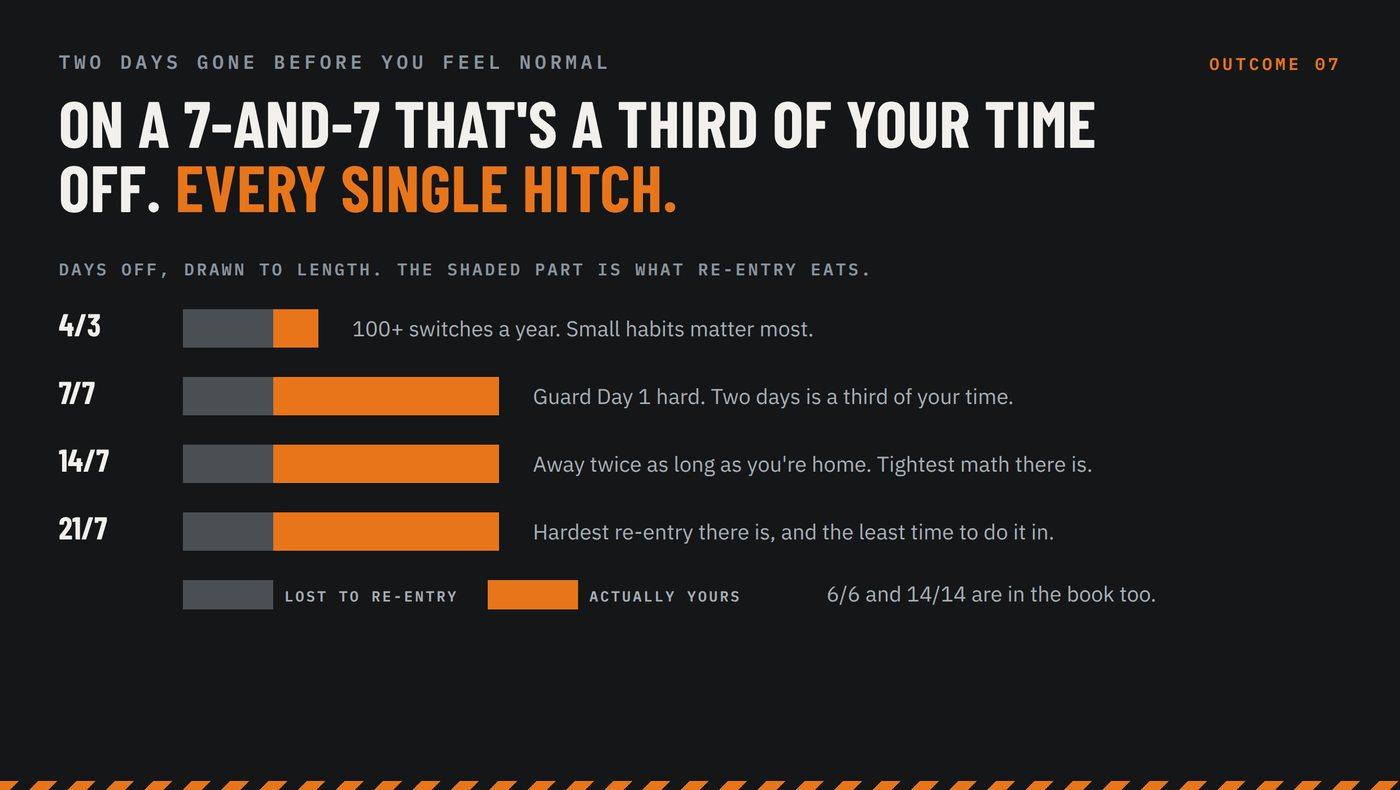
The shorter your hitch, the more often you run the switch. On a 4-and-3, a five-minute habit runs over a hundred times a year.
The longer your hitch, the harder each switch hits. On a 21-and-7 you've been gone three weeks and you've got one to land, live and leave again.
Pattern with no name? 8-and-6, turnarounds, call-outs, a board that changes every month? Count your own switches per year and the book tells you which of the two rules you're living under.
Camp or drive-in. Both, every time.
Some of you fly out and get a two-hour gap between site and your front door. Plenty of you drive in from town and get thirty minutes on the highway.
Two different problems. Every card in this guide is written for both.
And if you drive in, you run a compressed version of this switch twice a day. Over four hundred a year — more than anybody in camp.
Partner, kids, or nobody
The switch doesn't care who's waiting for you. Where the details change, the book says so.
There's a section for kids on night one, and one for the handover with a partner.
And a section written for walking into an empty house.
Nothing in here assumes there's someone at the door.
Trades, all of them
Scaffolders. Pipefitters. Welders. Millwrights. Electricians. Instrument techs. Insulators. Operators. Labourers. Safety. Camp kitchen and camp services. Drivers. Admin. Turnaround hands. Anybody on the oil patch working a hitch.
Written for men and women both
Gender-neutral the whole way through. Not as a disclaimer at the front.
Nothing in here assumes the worker is a man and the person at home is a woman.
Staying connected in between
The switch works better on both ends if the middle isn't a black hole.
Chapter 9 is the On Mode half. When to call. What to talk about.
What not to try to fix from a camp room. And what to do with a small room and a long stretch.
What running it actually does
The four things that change
- You arrive already switched over instead of doing the changeover in your living room. The trip home stops being dead time and starts being the thing that does the work.
- You stop losing the first day or two to re-entry. On a 7-and-7 that's a third of your time off, twenty-six times a year. On a 21-and-7 it's most of what you've got.
- The last night stops going sideways. Not because you get better at arguing. Because the thing that causes it gets named out loud, in one clumsy sentence, before it turns into a fight.
- You go back with the next hitch handed over instead of just leaving. Calls at set times. What's coming up. What needs sorting before you go.
And a chapter that tells you when this book isn't the right tool, with real numbers in it.
What that actually looks like
It's a Friday about six weeks from now. Same bus, same highway, same bag.
You ran the card before you left site, so the job is closed out and the note is written. You spent the first third of the trip getting the hitch out of your system and the last third reading your messages properly instead of skimming them.
You come through the door and you don't say anything about the state of the kitchen.
You ask the one question. Then you stop talking and listen to the answer.
Nothing dramatic happens. Nobody cries. There's no scene.
The first ten minutes just go past without a single thing going wrong — and on Saturday morning you wake up already yourself, instead of spending the day catching up to it.
Six days later you say the clumsy sentence about hating to leave, and the last night doesn't go sideways.
That's the whole thing. It is not a big life change. It is four short procedures, run on the two days a hitch that decide the rest of it.
What you won't get is a promise about your relationship, your family, or how any conversation goes. Nobody honest can make one, and I'm not going to start on the page where I'm asking you for money.
What lands in your inbox, in about a minute
What you actually get

Read it · Print it · Or listen to the whole thing on the bus · All included at $67
The Hitch To Home Protocol — the book
11 chapters · 4 cards · 54 procedures
Every procedure tagged On Mode, Off Mode or The Switch. So you always know when to run it.
All six schedules get their own scaling. Camp and drive-in written for both, all the way through.
One trip home where you land right is a day off you don't have to spend recovering.
The Hitch To Home Protocol — the audiobook
Included. Not an upsell. Not a separate price.
The whole guide, read start to finish. Not a summary.
This is the one Protocol you'd actually want in your ears on the way home. That's the trip it's about.
Download it before you fly out. It works with no signal at all.
The Hitch Fit App
Free for 120 days — the whole guarantee window. Then $27 a month, cancel any time.
It knows which mode you're in before you open it, and it knows when your switch is coming.
It carries the four cards on site and off, in your pocket, offline in camp.
A habit or fitness app runs $80 a year at the honest low end. And every one of them assumes you get an evening.
The four cards, inside the book
- The Last Shift Card. The Switch Fifteen minutes before you leave site. Five steps: close the job out, the handover note, the condition check, the message, change out of it.
- The Travel Card. The Switch The trip in thirds — dump it, settle, load in. Plane, camp bus, or thirty minutes on the highway. The drive-in version is written separately.
- The First Night Card. Off Mode The highest-stakes night of your days off. The first ten minutes, the question to ask, the collision to name, kids, an empty house, and what not to fix tonight.
- The Go-Back Card. The Switch Pack two nights early. Name the last-night weirdness. Set up the hitch together. One normal thing. A real goodbye, even at 4 a.m. Then reverse the thirds on the way in.
Every card also appears as a one-page quick reference you can screenshot. Plus a chapter on staying connected on hitch, and a chapter on when it's more than the hitch.
Book, audiobook and the Hitch Fit App. One price.
Try It For Three Hitches — $67Book + audiobook + the Hitch Fit App · One payment of $67 · Full refund inside three hitches, keep everything
Before you buy, the honest part
What this will not do for you
- It won't fix your relationship. No book can and this one says so on its own back cover. What it fixes is the two hours before you walk in and the last night before you go.
- It won't make anybody else run it. Most of these cards are yours alone. A couple of them are things you say out loud first, and you go first.
- It won't make a hitch shorter. Three weeks away is three weeks away. What changes is what's left of you at either end of it.
- It won't work if you only read it. That's why the guarantee is three full hitches and not thirty days.
- It isn't treatment. Chapter 10 is short and written plainly, with real numbers in it — 988 and the Alberta Mental Health Help Line. If what's going on is bigger than the hitch, that chapter says so and points you somewhere better than a book.
What I can hand you is the procedure. You run it.
Included · Every copy, every tier
The book is in a drawer at home. The app is in your pocket at the end of shift.
Here's the problem nobody warns you about when they hand you a book.
It's brilliant on your days off. Couch, coffee, nodding along. This is finally the one that sticks.
Then it's the last shift of a hitch and you're wrecked. And the card you needed is three hundred kilometres away in a drawer.
Knowledge you can't reach in the moment isn't a method. It's a good intention.
That's the gap the app closes. The book teaches the method once. The app runs it with you, every changeover.
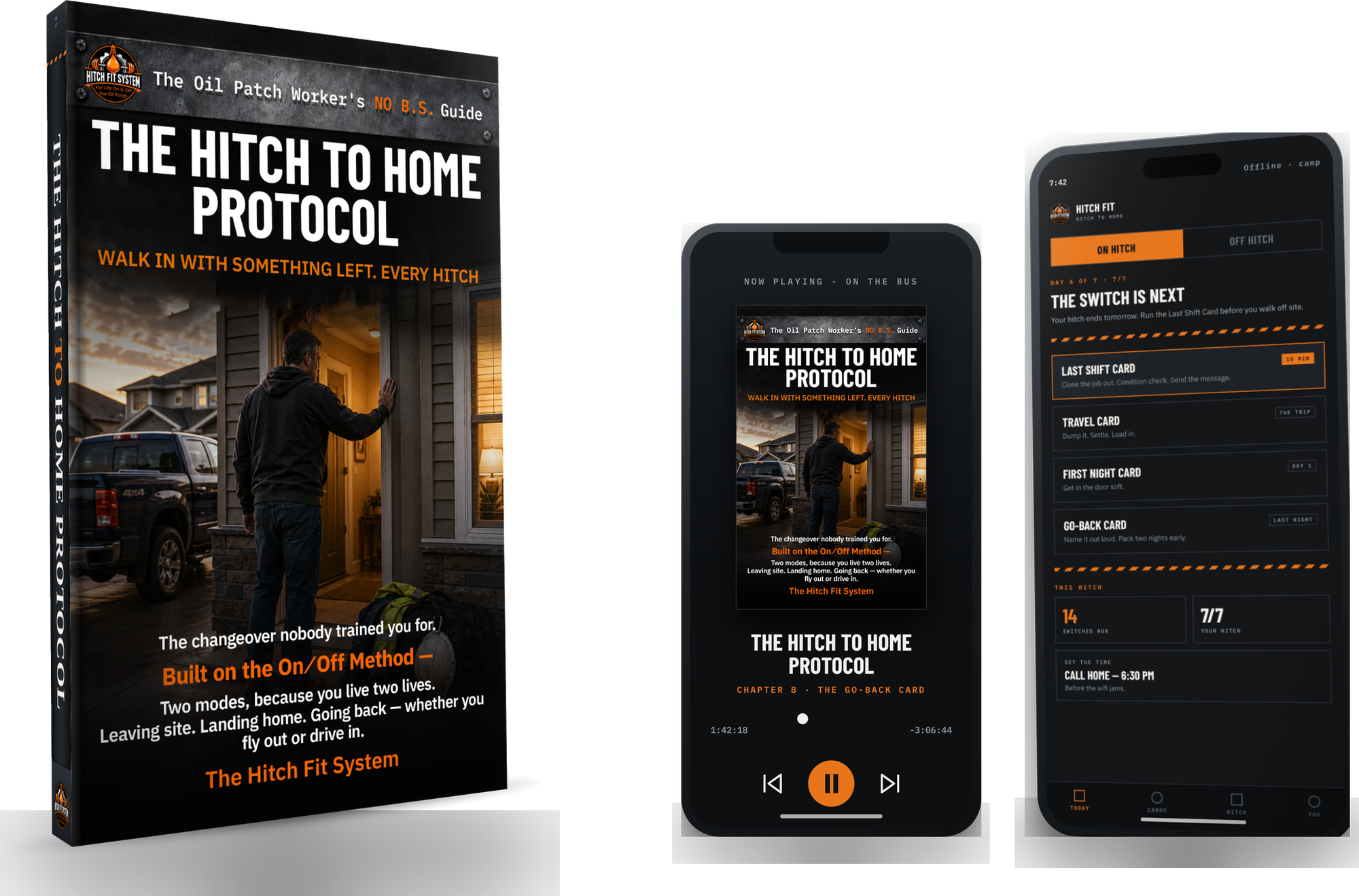
Book · Audiobook · The Hitch Fit App — all three, $67, no upsell on the way in
Six things you've said out loud. Solved by name.
Tap any one of them.
“I forget the whole thing until I'm already home.”
Set your hitch once at onboarding. 4/3, 6/6, 7/7, 14/7, 14/14, 21/7, or your own pattern.
The app builds a calendar and knows when your switch is coming — before you've opened it.
The Last Shift Card comes up on the last shift, not after you've landed.
“I'm not reading a book in the dry room with fifteen minutes to go.”
You're not meant to. Each card is one screen, in order, with the times on it.
Five steps for the Last Shift Card. Three parts for the Travel Card. Tap through them and you're done.
“Camp wifi is useless and I'm not downloading anything at 7 p.m.”
The cards work offline. Download once on decent wifi and they're yours in the camp room with no signal at all.
Same as the audiobook. That's deliberate — half of this is used in places with no bars.
“I never remember what I said I'd sort out before next hitch.”
That's the handover note from Chapter 3, in the app instead of buried in your phone's notes.
Write it on the last shift. It comes back up on the trip in, which is exactly when you need it.
“Nobody's checking, so it's easy to let a hitch slide.”
The app tracks switches run, not days logged. Your unit is a hitch, so that's the unit it counts.
Streaks, a hitches-completed count and milestone markers give you something to watch build.
“We always mean to set a call time and then we don't.”
Set it once and it holds for the hitch. The app nudges you at the time you picked, not whenever it feels like it.
Set it early rather than right after change. That's Chapter 9's point about a few thousand people all calling home at once.
What day one actually gives you
Onboarding takes a few minutes. Set your hitch, set your call time, and the calendar does the rest.
From then on the app knows whether today is On Mode, Off Mode, or one of your two switch days.
Then: run the card the app puts in front of you. Let the calendar handle the changeovers — it already knows when they are.
Book + audiobook + the Hitch Fit App · One payment of $67 · Full refund inside three hitches, keep everything
The price
Once. Book, Audiobook and The Hitch Fit App.
I'm not going to compare that to another book. Here's what I'll compare it to.
| What it costs | What it can't do |
|---|---|
| $2M over a career | What this work pays a man without a degree. The question was never whether you’d earn it. It’s what’s left of you to spend it on. |
| 2 days every hitch | Lost to re-entry. On a 7-and-7 that's a third of your time off, and it happens twenty-six times a year. |
| 100+ switches a year | What a 4-and-3 runs. Every one of them currently run on nothing but hope. |
| 1 night the last one | The argument that turns up out of nowhere, every hitch, for years. Nobody's ever told you why it happens. |
| $80 a year, min. | A habit or fitness app subscription — billed forever, and it assumes you get an evening. Yours is in the $67, once. |
| Every hitch left | The changeovers add up quietly. And the version of you who finally walks out of here to collect. |
$67 is a round of drinks on your first night home. Or half a tank in the truck.
It's also less than what one wasted day off is worth to you, and you're currently spending two of them a hitch.
You’ll earn two million dollars doing this job. This is sixty-seven of them, once, to make sure there’s something left to spend it on.
My “measured in hitches, not days” guarantee
Three full hitches. Then decide.
Run it for three full hitches. Not read it — run it. If it hasn't earned its place in your kit by the end of hitch three, email us and we'll refund you in full. You keep the books.
Three hitches, because thirty days means nothing on a 21/7. Thirty days is a hitch and a bit.
It doesn't even give you three trips home. Let alone three go-backs.
Your unit is a hitch. So the guarantee is in hitches. There's a 120-day outer window either way.
To be plain: it's a refund guarantee on the method.
It is not a promise about your relationship, your family, or how any conversation goes. Nobody honest can promise you that.
So run this one for three hitches and find out. That's the whole offer.
If it doesn't hold, I'd rather have your feedback than your $67.
And you keep the books either way. Chasing someone for a refunded file is not a business I want to be in.
Book + audiobook + the Hitch Fit App · One payment of $67 · Full refund inside three hitches, keep everything
One thing that does run out
100 seats. Closes October 10.
There's no cap on this book. No countdown clock. No “only 3 left.” No stock counter ticking while you read.
Buy it whenever you want. If you're reading this in March, it's still $67.
The one thing with a limit is the Founding Crew. That's The Complete System at $197.
All five books, all five audiobooks, the app. Plus lifetime updates and direct input on what gets built next.
The cap is 100 and it closes October 10. After that the Complete System is $297 and the Founding Crew doesn't reopen.
That's not a countdown gimmick. It's the number of people one person on a hitch schedule can actually talk to.
Take all five — Founding Crew $197 →Take all five — The Complete System $297 →
Here's what to do next
Have it before your next trip home
Hit the button. Put in your email. The book and the audiobook land in your inbox in about a minute, from BookFunnel.
Download them on decent wifi before you fly out. Then they're yours offline.
Phone, tablet, laptop, or print the cards for your kit bag.
Camp wifi that dies every time somebody streams a game is not your problem here.
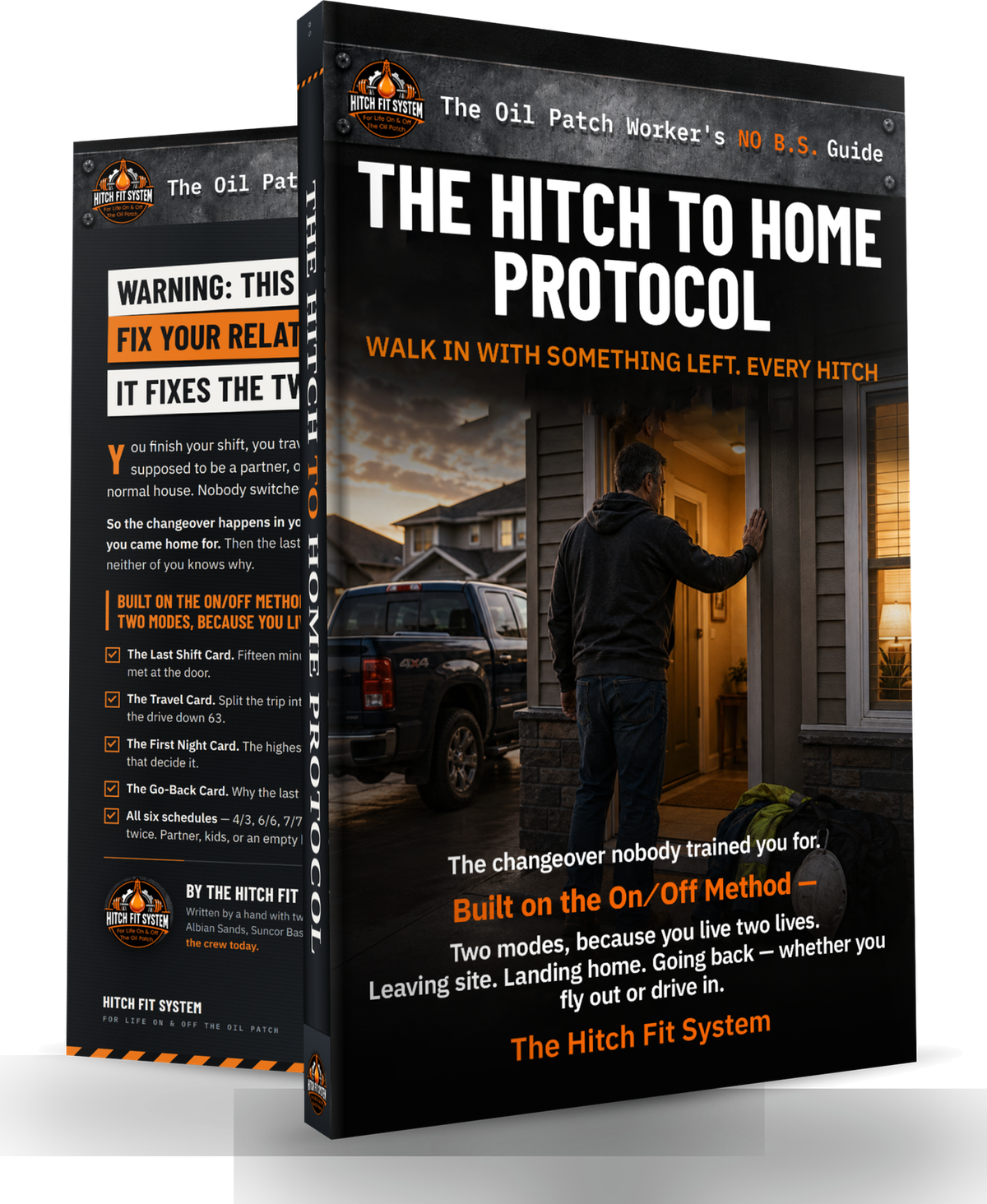
The Hitch To Home Protocol · Book + audiobook + app
One payment for the book and the audiobook · App free 120 days, then $27/mo
Book + audiobook + the Hitch Fit App · One payment of $67 · Full refund inside three hitches, keep everything
Walk in with something left. Every hitch.
The next changeover is coming either way. The last shift will be there. The trip will be there. The last night before you go back will be there.
The only question is whether you walk into them with a procedure or with a hope.
The job is supposed to pay for the life. Too many people out here let it eat the life instead.
The Hitch Fit System Team
Twelve years of hitches, and counting · Still on the crew
P.S.
You made it to the bottom of a long page. That's more patience than the tool crib line on a turnaround, so here's the short version for the skimmers.
You're not distant. You're running a changeover nobody ever trained you for, twice a hitch.
This book gives you four short cards. Leaving site. The trip. The first night. The go-back.
$67 gets you the book, the audiobook and the app. Three full hitches to try it. Full refund, keep the books.
Double P.S.
Still reading? Alright. Here's the thing I'd tell you standing in the dry room waiting on a ride.
The three cheapest things in this whole book are free and take about a minute between them.
Send the message before you leave site. No criticism in the first ten minutes. Name the last-night weirdness out loud.
Do only those three and you'll notice a difference this hitch.
That's not a sales line. It's Chapter 11, and it's there for the hitches when you won't have it in you to run the rest.
Triple P.S.
Okay, what do you need — a signed affidavit? A ride to the bus?
Look. Worst case: you spend $67 and run it for three hitches.
It doesn't earn its spot. You email us. We refund you. And you keep the books.
You're out precisely nothing, and you got a free audiobook for the trip home.
Best case: you walk in your own door on Friday and you're actually there.
Hit the button. Then go pack your bag — two nights early.
Get The Hitch To Home Protocol Now!Book + audiobook + the Hitch Fit App · One payment of $67 · Full refund inside three hitches, keep everything
Straight answers
Questions folks on the oil patch ask
“I've only got thirty minutes in the truck, not a two-hour flight.”
Then you're the reader Chapter 4's second half was written for.
Ten minutes to dump it. Ten minutes quiet. Ten minutes to load in. Same three parts, compressed.
And understand what you're actually dealing with: you run this switch twice a day, every working day. Over four hundred a year.
Everybody assumes camp workers have it harder because they're away. You never get a clean break from either side.
“My partner isn't going to sit down and do a handover with me.”
Most of the book doesn't need them to. The Last Shift Card, the Travel Card and the trip in are all yours alone.
The first ten minutes home is yours too. So is not fixing anything on night one.
The two that involve saying something out loud take about fifteen seconds each, and you go first.
If they never join in, you still get most of it. That's how it's built.
“I go home to an empty house. Is this even for me?”
Yes, and it's written that way rather than bolted on.
Chapter 5 has its own section for arriving to nobody. Including the two things that stop the whole stretch turning into three days on the couch.
One of them you do before you leave the time before. The other is a single appointment on Day 2.
Nothing in this book assumes there's someone at the door.
“My schedule isn't on your list.”
4-and-3, 6-and-6, 7-and-7, 14-and-7, 14-and-14 and 21-and-7 each get their own scaling.
Anything else? 8-and-6, turnarounds, call-outs, a board that changes monthly.
Count your own switches per year. Short hitches run the switch constantly. Long hitches hit harder each time.
The book tells you which of the two you're living under.
“Isn't this just common sense?”
Some of it, yes. So is protein first, and people still don't do it.
The parts that aren't: that the fight lands on the last night and why. That your kid being shy isn't rejection. That you feel the separation more sharply than your partner does — which is the opposite of what nearly everybody assumes.
And the biggest one: that the trip home is the only gap you get, and almost nobody uses it.
“What if it's worse than a bad first day?”
Then this is the wrong tool on its own, and the book says so plainly in Chapter 10.
That chapter has real numbers in it. 988, the Alberta Mental Health Help Line, and your employer or contractor's assistance program.
Reaching out isn't soft. It's the same call you'd make if a load shifted.
There is no version of this where asking is the weak move.
“Is it for women too?”
Yes, and it's written that way throughout — not with a disclaimer at the front.
Nothing in here assumes the worker is a man and the person at home is a woman.
Operators, trades, engineers, safety, camp kitchen and camp services, drivers, admin. Men and women. The switch doesn't care what your job title is.
“What device? Does it work on camp wifi?”
Phone, tablet, laptop, or print it. Download it once on decent wifi and it's yours offline after that.
The audiobook downloads the same way. Grab it before you fly out and it works with no signal at all.
The app's cards work offline too. That's deliberate — most of this gets used where there are no bars.
“What exactly am I getting?”
A quarter section near Sundre, a heated shop and a two-post lift.
…Alright, no. You're getting The Hitch To Home Protocol. 11 chapters, 4 cards, 54 procedures, all six schedules.
As a book, the full audiobook, and the Hitch Fit App. Delivered in about a minute, for $67, once.
The app ships with every copy. There is no audio tier, no app tier, and no upsell on the way in.
“Which of the five should I start with?”
Honest answer: if your time off collapses partway through, start with Days Off. If you're losing days to a flip, start with Sleep.
Start here if the first day home is the strange part, or if the last night keeps going wrong.
This one is the switch, and every other Protocol depends on it working. Come home wrecked and take two days to feel normal, and you've just lost two days of everything else.
“Is the guarantee real?”
Run it for three full hitches. Not read it — run it. If it hasn't earned its place in your kit by the end of hitch three, email us and we'll refund you in full, and you keep the books. There's a 120-day outer window on it either way.
It's a refund guarantee on the method. Not a promise about your relationship or your family.
Be suspicious of anyone who gives you one of those in writing.
“What are the other four?”
Body, Sleep, Drive and Days Off.
All five run on the same two modes. Because your body is not the only thing the hitch is taking, and the other four Protocols are Body, Sleep, Drive and Days Off.
All five together are The Complete System at $297. Five books, five audiobooks, the app.
Or $197 for the Founding Crew. That adds lifetime updates and direct input on what gets built next.
Capped at 100. Closes October 10.
However many hitches you've got left. Be there for the half you're home.
Be There From The Hour You Walk In — $67Book + audiobook + the Hitch Fit App · One payment of $67 · Full refund inside three hitches, keep everything